Applied System
Enable Data Exports Automation
Overiew
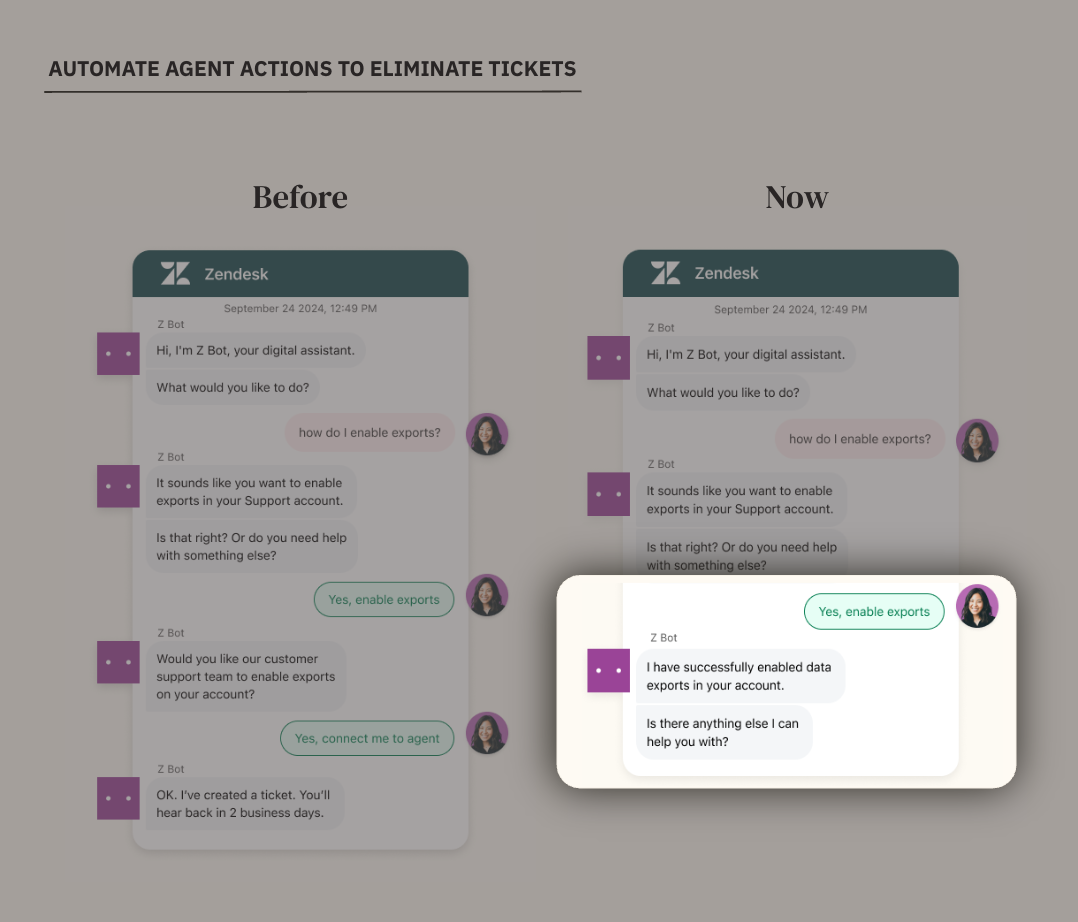
Data export requests came in constantly at Zendesk. Each one required a specialist to confirm user authorization, check account eligibility, and manually enable the feature. High volume, repetitive logic, and no reason for a human to sit in the middle of it once the decision rules were known.
I mapped the end-to-end workflow and translated it into a read-write automation the bot could execute safely. The system verified user identity, checked eligibility against strict rules, triggered the API call to enable exports, and closed the loop in conversation. The customer received confirmation without being redirected or waiting for manual intervention.
This was the first of five API-powered automations I architected at Zendesk and became the pattern for a larger class of conversational actions that completed real backend changes, not just content routing.
Purpose
Turn a high-frequency, eligibility-gated request into a fully automated workflow that resolved inside the conversation instead of becoming a ticket.
System Architecture
1. Inputs
- Eligibility rules
- Authorization requirements
- Backend API endpoints
- Conversation entry points and phrasing
2. Decision Logic
- Identity verification
- Eligibility validation
- Safe read-write conditions
- Failure and fallback paths
3. Automation Output
- API-triggered feature enablement
- Real-time confirmation message
- Prompt for next steps (“anything else?”)
- No human intervention unless rules fail
Patterns Identified
- Many “specialist-only” tasks are rule-based, not judgment-based
- Eligibility checks follow a repeatable structure
- Customers are more satisfied with in-conversation resolutions than redirects
- Read-write automations reduce routing load significantly
- Backend-triggered actions require strict guardrails, not ad hoc design
Impact
- Major ticket reduction for data-export requests
- Faster resolution with no manual steps
- Less operational load on specialists
- Established the blueprint for future backend automations
- Demonstrated safe, scalable read-write capability inside the bot
Applied System
Enable Data Exports Automation
Overiew
Data export requests came in constantly at Zendesk. Each one required a specialist to confirm user authorization, check account eligibility, and manually enable the feature. High volume, repetitive logic, and no reason for a human to sit in the middle of it once the decision rules were known.
I mapped the end-to-end workflow and translated it into a read-write automation the bot could execute safely. The system verified user identity, checked eligibility against strict rules, triggered the API call to enable exports, and closed the loop in conversation. The customer received confirmation without being redirected or waiting for manual intervention.
This was the first of five API-powered automations I architected at Zendesk and became the pattern for a larger class of conversational actions that completed real backend changes, not just content routing.
Purpose
Turn a high-frequency, eligibility-gated request into a fully automated workflow that resolved inside the conversation instead of becoming a ticket.
System Architecture
1. Inputs
- Eligibility rules
- Authorization requirements
- Backend API endpoints
- Conversation entry points and phrasing
2. Decision Logic
- Identity verification
- Eligibility validation
- Safe read-write conditions
- Failure and fallback paths
3. Automation Output
- API-triggered feature enablement
- Real-time confirmation message
- Prompt for next steps (“anything else?”)
- No human intervention unless rules fail
Patterns Identified
- Many “specialist-only” tasks are rule-based, not judgment-based
- Eligibility checks follow a repeatable structure
- Customers are more satisfied with in-conversation resolutions than redirects
- Read-write automations reduce routing load significantly
- Backend-triggered actions require strict guardrails, not ad hoc design
Impact
- Major ticket reduction for data-export requests
- Faster resolution with no manual steps
- Less operational load on specialists
- Established the blueprint for future backend automations
- Demonstrated safe, scalable read-write capability inside the bot
Applied System
Enable Data Exports Automation
Overiew
Data export requests came in constantly at Zendesk. Each one required a specialist to confirm user authorization, check account eligibility, and manually enable the feature. High volume, repetitive logic, and no reason for a human to sit in the middle of it once the decision rules were known.
I mapped the end-to-end workflow and translated it into a read-write automation the bot could execute safely. The system verified user identity, checked eligibility against strict rules, triggered the API call to enable exports, and closed the loop in conversation. The customer received confirmation without being redirected or waiting for manual intervention.
This was the first of five API-powered automations I architected at Zendesk and became the pattern for a larger class of conversational actions that completed real backend changes, not just content routing.
Purpose
Turn a high-frequency, eligibility-gated request into a fully automated workflow that resolved inside the conversation instead of becoming a ticket.
System Architecture
1. Inputs
- Eligibility rules
- Authorization requirements
- Backend API endpoints
- Conversation entry points and phrasing
2. Decision Logic
- Identity verification
- Eligibility validation
- Safe read-write conditions
- Failure and fallback paths
3. Automation Output
- API-triggered feature enablement
- Real-time confirmation message
- Prompt for next steps (“anything else?”)
- No human intervention unless rules fail
Patterns Identified
- Many “specialist-only” tasks are rule-based, not judgment-based
- Eligibility checks follow a repeatable structure
- Customers are more satisfied with in-conversation resolutions than redirects
- Read-write automations reduce routing load significantly
- Backend-triggered actions require strict guardrails, not ad hoc design
Impact
- Major ticket reduction for data-export requests
- Faster resolution with no manual steps
- Less operational load on specialists
- Established the blueprint for future backend automations
- Demonstrated safe, scalable read-write capability inside the bot