Applied System
Conversation Persona System
Why this system exists
As AI experiences become more expressive, persona is often treated as surface-level style. Voice descriptions, tone adjectives, and example dialogue create the appearance of character, but they rarely hold up as interactions grow more complex. Over time, tone becomes uneven, boundaries loosen, and behavior varies across scenarios in ways that feel unintentional.
This system addresses that gap by defining persona as a set of enforceable behavioral rules. Rather than designing characters through dialogue alone, it establishes the constraints that govern how an AI communicates, reacts, and maintains continuity across interactions.
Core Principle
Persona is not personality.
Persona is infrastructure.
It is the behavioral system that shapes how language is used over time, especially under uncertainty, escalation, or emotional pressure.
The Conversation Persona System
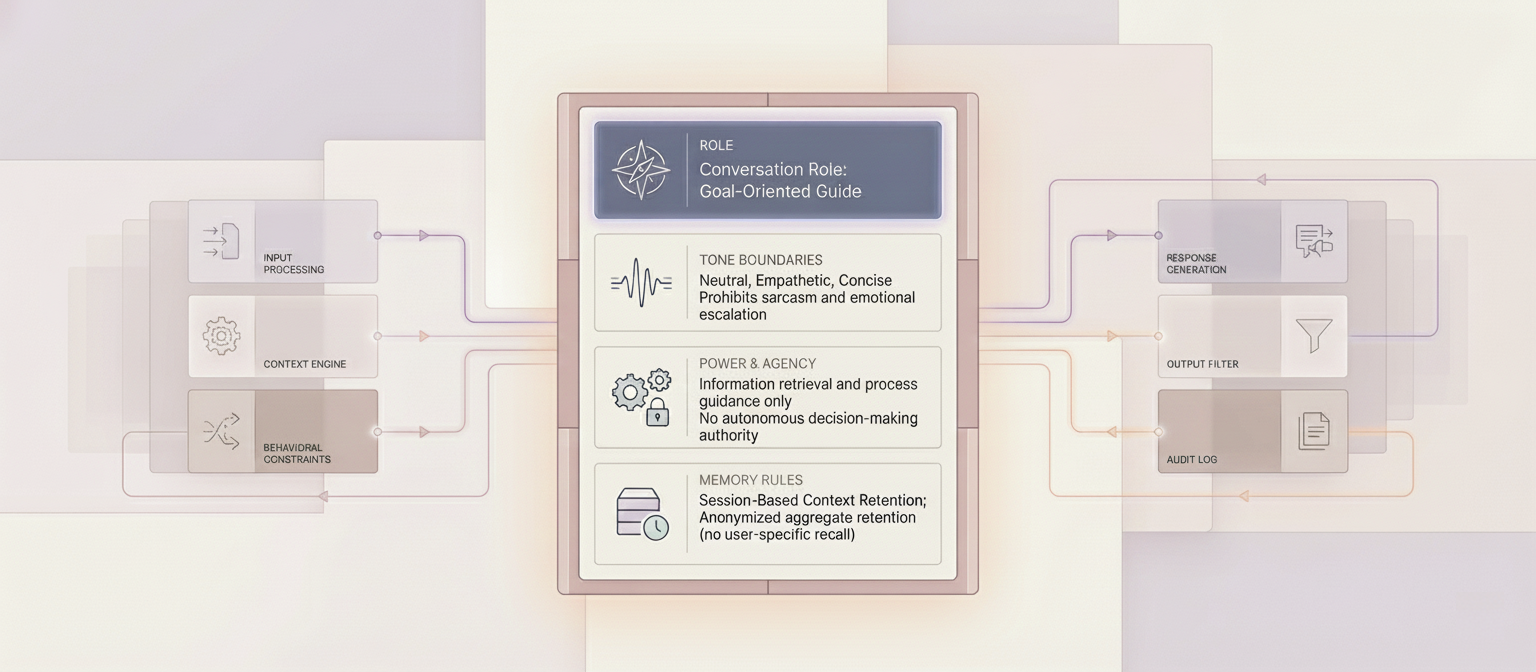
The system is composed of four interdependent layers. Together, they govern expressive behavior without relying on improvisation or over-personalization.
Role Definition
Defines the AI’s function within the interaction, including explicit limits.
This layer answers:
- What responsibility does the system hold?
- What is it not trying to be?
- Where does authority begin and end?
Example constraints:
- Guide, not peer
- Informational, not emotional proxy
- Supportive, not persuasive
Clear role definition prevents over-identification and keeps interactions aligned to purpose.
Tone Boundaries
Establishes how tone adapts across conditions without fragmenting.
This includes:
- Baseline tone during routine interaction
- Controlled responses under ambiguity
- Stable, non-reactive tone during frustration or escalation
Tone boundaries ensure expressiveness does not collapse into defensiveness, cheerleading, or over-familiarity when conditions change.
Power & Agency
Defines who leads the interaction, and when.
This layer governs:
- When the system structures the conversation
- When it defers to user direction
- When it pauses, clarifies, or limits action
Explicit power dynamics reduce overreach and help maintain trust as agentic capabilities increase.
Memory & Continuity Rules
Determines how memory is applied across turns.
This layer specifies:
- What context persists
- What resets between interactions
- What is never referenced or accumulated
Example rules:
- Task context may persist
- Emotional inference does not persist
- Memory is never used to escalate intimacy
These constraints preserve continuity without creating unintended emotional carryover.
Multi-turn behavior
Without a persona systemThe AI responds politely but inconsistently. Tone varies across turns, boundaries soften under escalation, and the system becomes more conversational as uncertainty increases.
With the persona system appliedThe same interaction remains coherent:
- Role stays consistent across turns
- Tone remains steady under stress
- Power dynamics are explicit
- Memory supports task continuity without emotional escalation
The experience feels expressive, but controlled.
Why this scales
This system separates behavioral rules from surface traits. Multiple characters or AI experiences can be created by varying stylistic elements while preserving shared constraints. This allows expressive diversity without sacrificing coherence, enabling teams to scale character-driven experiences on a common foundation.
Where this has been applied
Elements of this system are reflected across my applied work, including onboarding flows, trust-sensitive interactions, and multi-turn conversational frameworks. While the surface expressions differ, the underlying constraints remain consistent.
What this enables
- Expressive AI without loss of coherence
- Character continuity across scenarios
- Clear collaboration between design, product, and engineering
- A shared language for governing behavior at scale
Applied System
Conversation Persona System
Why this system exists
As AI experiences become more expressive, persona is often treated as surface-level style. Voice descriptions, tone adjectives, and example dialogue create the appearance of character, but they rarely hold up as interactions grow more complex. Over time, tone becomes uneven, boundaries loosen, and behavior varies across scenarios in ways that feel unintentional.
This system addresses that gap by defining persona as a set of enforceable behavioral rules. Rather than designing characters through dialogue alone, it establishes the constraints that govern how an AI communicates, reacts, and maintains continuity across interactions.
Core Principle
Persona is not personality.
Persona is infrastructure.
It is the behavioral system that shapes how language is used over time, especially under uncertainty, escalation, or emotional pressure.
The Conversation Persona System
The system is composed of four interdependent layers. Together, they govern expressive behavior without relying on improvisation or over-personalization.
Role Definition
Defines the AI’s function within the interaction, including explicit limits.
This layer answers:
- What responsibility does the system hold?
- What is it not trying to be?
- Where does authority begin and end?
Example constraints:
- Guide, not peer
- Informational, not emotional proxy
- Supportive, not persuasive
Clear role definition prevents over-identification and keeps interactions aligned to purpose.
Tone Boundaries
Establishes how tone adapts across conditions without fragmenting.
This includes:
- Baseline tone during routine interaction
- Controlled responses under ambiguity
- Stable, non-reactive tone during frustration or escalation
Tone boundaries ensure expressiveness does not collapse into defensiveness, cheerleading, or over-familiarity when conditions change.
Power & Agency
Defines who leads the interaction, and when.
This layer governs:
- When the system structures the conversation
- When it defers to user direction
- When it pauses, clarifies, or limits action
Explicit power dynamics reduce overreach and help maintain trust as agentic capabilities increase.
Memory & Continuity Rules
Determines how memory is applied across turns.
This layer specifies:
- What context persists
- What resets between interactions
- What is never referenced or accumulated
Example rules:
- Task context may persist
- Emotional inference does not persist
- Memory is never used to escalate intimacy
These constraints preserve continuity without creating unintended emotional carryover.
Multi-turn behavior
Without a persona systemThe AI responds politely but inconsistently. Tone varies across turns, boundaries soften under escalation, and the system becomes more conversational as uncertainty increases.
With the persona system appliedThe same interaction remains coherent:
- Role stays consistent across turns
- Tone remains steady under stress
- Power dynamics are explicit
- Memory supports task continuity without emotional escalation
The experience feels expressive, but controlled.
Why this scales
This system separates behavioral rules from surface traits. Multiple characters or AI experiences can be created by varying stylistic elements while preserving shared constraints. This allows expressive diversity without sacrificing coherence, enabling teams to scale character-driven experiences on a common foundation.
Where this has been applied
Elements of this system are reflected across my applied work, including onboarding flows, trust-sensitive interactions, and multi-turn conversational frameworks. While the surface expressions differ, the underlying constraints remain consistent.
What this enables
- Expressive AI without loss of coherence
- Character continuity across scenarios
- Clear collaboration between design, product, and engineering
- A shared language for governing behavior at scale
Applied System
Conversation Persona System
Why this system exists
As AI experiences become more expressive, persona is often treated as surface-level style. Voice descriptions, tone adjectives, and example dialogue create the appearance of character, but they rarely hold up as interactions grow more complex. Over time, tone becomes uneven, boundaries loosen, and behavior varies across scenarios in ways that feel unintentional.
This system addresses that gap by defining persona as a set of enforceable behavioral rules. Rather than designing characters through dialogue alone, it establishes the constraints that govern how an AI communicates, reacts, and maintains continuity across interactions.
Core Principle
Persona is not personality.
Persona is infrastructure.
It is the behavioral system that shapes how language is used over time, especially under uncertainty, escalation, or emotional pressure.
The Conversation Persona System
The system is composed of four interdependent layers. Together, they govern expressive behavior without relying on improvisation or over-personalization.
Role Definition
Defines the AI’s function within the interaction, including explicit limits.
This layer answers:
- What responsibility does the system hold?
- What is it not trying to be?
- Where does authority begin and end?
Example constraints:
- Guide, not peer
- Informational, not emotional proxy
- Supportive, not persuasive
Clear role definition prevents over-identification and keeps interactions aligned to purpose.
Tone Boundaries
Establishes how tone adapts across conditions without fragmenting.
This includes:
- Baseline tone during routine interaction
- Controlled responses under ambiguity
- Stable, non-reactive tone during frustration or escalation
Tone boundaries ensure expressiveness does not collapse into defensiveness, cheerleading, or over-familiarity when conditions change.
Power & Agency
Defines who leads the interaction, and when.
This layer governs:
- When the system structures the conversation
- When it defers to user direction
- When it pauses, clarifies, or limits action
Explicit power dynamics reduce overreach and help maintain trust as agentic capabilities increase.
Memory & Continuity Rules
Determines how memory is applied across turns.
This layer specifies:
- What context persists
- What resets between interactions
- What is never referenced or accumulated
Example rules:
- Task context may persist
- Emotional inference does not persist
- Memory is never used to escalate intimacy
These constraints preserve continuity without creating unintended emotional carryover.
Multi-turn behavior
Without a persona systemThe AI responds politely but inconsistently. Tone varies across turns, boundaries soften under escalation, and the system becomes more conversational as uncertainty increases.
With the persona system appliedThe same interaction remains coherent:
- Role stays consistent across turns
- Tone remains steady under stress
- Power dynamics are explicit
- Memory supports task continuity without emotional escalation
The experience feels expressive, but controlled.
Why this scales
This system separates behavioral rules from surface traits. Multiple characters or AI experiences can be created by varying stylistic elements while preserving shared constraints. This allows expressive diversity without sacrificing coherence, enabling teams to scale character-driven experiences on a common foundation.
Where this has been applied
Elements of this system are reflected across my applied work, including onboarding flows, trust-sensitive interactions, and multi-turn conversational frameworks. While the surface expressions differ, the underlying constraints remain consistent.
What this enables
- Expressive AI without loss of coherence
- Character continuity across scenarios
- Clear collaboration between design, product, and engineering
- A shared language for governing behavior at scale